
Yes, Almonds Use Water. Here’s the Rest of the Story.

It’s not about how much they’re using, but what they’re doing with every drop.

Christine Gemperle has watched it happen on her own land. An excavator works down the rows, pushing over mature almond trees, and a tub grinder follows behind, chewing whole trunks into chips piled as tall as a two-story house. “It is equally fascinating and terrifying,” she says. On her westside ranch, when water grew scarce and expensive, she and her brother Erich made the call to stop pumping groundwater and pull an orchard early. It just didn’t pencil out anymore.

Stories like hers are showing up across the Central Valley. Since 2022, California’s bearing almond acreage has begun to ease back after years of steady growth, with the pullback concentrated where water is least secure. It is a real adjustment. It’s not, however, an industry in retreat: California still grows roughly 80% of the world’s almonds, and the state remains the right place to grow them.

What’s driving the removals isn’t water alone. Planting and replanting costs have climbed sharply in recent years, stretching out how long it takes a new orchard to pay for itself. Add tightening groundwater access under the Sustainable Groundwater Management Act (SGMA), and where that math stops working, trees come out. More of them will, concentrated in the areas where water is hardest to come by.

The loss of an orchard is felt first in the town: the seasonal jobs, the hauler, the equipment dealer, the rural tax base that can least afford the hit. Caitlin Peterson, associate director of the Water Policy Center at the Public Policy Institute of California (PPIC), has spent years studying what groundwater limits will mean for the Valley, and she doesn’t soften it. The state’s aquifers have to come back into balance, which means some land will come out of production. SGMA is “working as intended,” she says.   But this isn’t a farewell. Almonds aren’t going anywhere, and California has real reasons to want them to stay. The acres that remain will have to keep doing what the best of them already do: use water precisely, extract more value from it, and give some of it back.

Grower fixing microsprinkler

The Trouble With “Almonds Versus Water”

All food takes water to grow, almonds included. And in California, where agriculture is always being asked to do more with less, every crop has to earn its share. So why do growers keep planting almonds? Start with everything an orchard holds up. These are overwhelmingly family operations. Nine in ten California almond farms are family-run, most of them under a hundred acres, and they anchor Central Valley towns where agriculture is the economy. The industry supports more than 110,000 jobs statewide, and that footing sits inside a much larger California problem. PPIC projects that between tightening groundwater rules, climate variation, and new environmental regulations, San Joaquin Valley growers across all crops could lose up to a fifth of the water available for irrigation by 2040, pushing between 500,000 and 900,000 acres of farmland out of full production.

When an orchard comes out, as Gemperle puts it, the loss “doesn’t just stop at the edge of the field.” It reaches the tree nursery and the trucking outfit. It reaches the food banks and community groups that Valley farmers have long helped keep afloat.

The crop that stays is one the region can lean on: storable, shippable, sellable, grown on land that keeps a good part of the Valley working.

None of that settles the harder question, which is whether the water itself is being spent wisely. The water conversation almost always pits almonds against water, as though pulling the trees automatically gives the water back. But it doesn’t work that cleanly. Dr. Nicolas Bambach, UC Davis scientist, has measured water use across almonds and other California commodities, and finds they draw broadly similar amounts. The problem, as he sees it, isn't almonds. It's the instinct to find one culprit at all.

Tom Devol Irrigation Pump

What sets almonds apart is commitment, not thirst. An annual crop can sit fallow through a dry year; a twenty-five-year orchard cannot, which is why tighter groundwater rules land harder on perennials than on row crops.

Peterson, who studies water policy, sees it the same way. Singling out one crop is rarely useful, she argues, because water flows to whatever crop earns the most on that land, and for years that has been almonds. She points to a longer trend as well: California farms grow substantially more food today than they did in the 1980s while using about the same amount of water. Almonds are a part of that record, not an exception to it.

Trace a Drop of Water Through an Almond Orchard

One drop of water can grow a kernel, a hull, a shell, and a tree, and still have work left to do. Here’s how.

Rooted in the valley
Rooted in the Valley
delivered precisely icon
Delivered Precisely
growing four crops icon
Growing Four Crops
upcycling the harvest icon
Upcycling the Harvest
avoiding food waste icon
Avoiding Food Waste
returning water underground icon
Returning Water Underground
working habitat
Working Habitat

The New Precision of Irrigation

Efficiency in an almond orchard starts with arithmetic. Gemperle has paid as little as $25 an acre-foot for water in a wet year and as much as $750 in a drought. At those prices, she says, “you don’t waste a drop and you hunt for ways to conserve.” 

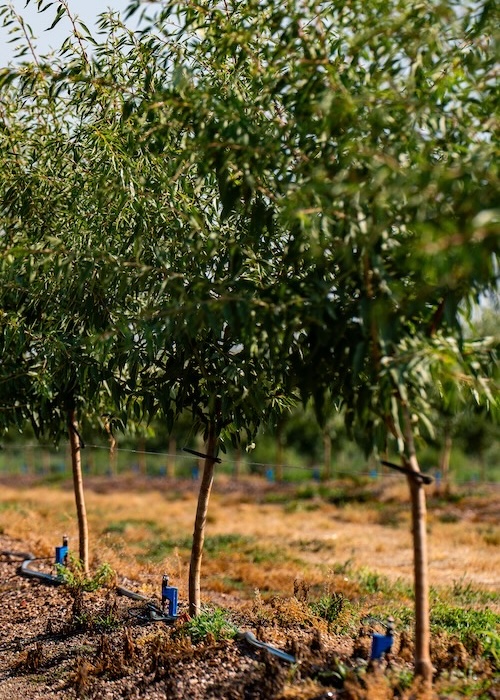
Most California almond growers have converted to micro-irrigation, roughly 88% of them, against 56% of the state’s farms overall. Drippers and micro-sprinklers place water at the root zone in small doses, so the tree takes it up before it sinks past the roots or evaporates off the surface. As Bambach has it, modern systems run near 90% efficiency. “Of every 10 drops of water put into the soil, the plant uses 9,” he says. Older surface methods only managed 50% to 60%. The cumulative result is that growing a pound of almonds now takes about a third less water than it did a few decades ago. The gains compound at scale: Bambach’s research found that a 10% reduction in almond irrigation statewide would save roughly as much water as a third of what Lake Oroville holds.

 Per-pound efficiency is not the same as a small footprint. Almond Board of California’s analysis finds that almonds grow on 19.4% of California's irrigated farmland,¹ ² using 18% of the water California devotes to growing food³ ⁴ ⁵ — less than a proportionate share. Please see table below. 

But the research has moved past simply using less. Bambach’s team studies timing and variation across a single orchard, and he offers a familiar example of getting it wrong: sprinklers running on campus lawns at midday, most of that water evaporating before any plant drinks it. “Ideally, we conserve water by giving plants the water they need, when they need it,” he says. Satellite tools like OpenET now estimate daily orchard water use in near real time, and Bambach’s team is working directly with growers to fold that information into the decisions they’re already making every season.

“ A 10% reduction in almond irrigation statewide could save about as much water as one-third of Lake Oroville holds.
DR. NICOLAS BAMBACH, UC DAVIS SCIENTIST ON HOW ALMOND FARMER ADOPTION OF PRECISION IRRIGATION IS CONSERVING WATER.

Four Crops for Every Drop

“Everything we grow, nuts, shells, hulls and the wood from the trees has a purpose,” Gemperle says. That turns out to be a water argument as much as a waste one, since one irrigation season produces all four. Shells go to livestock bedding and, increasingly, into composite materials that replace some petroleum-based plastics; the wood goes back into the ground when an orchard is replanted.

The hulls make the clearest case. They have long gone to dairies, where they can replace alfalfa hay pound for pound in up to a fifth of a cow’s diet. Since alfalfa is itself irrigated, every acre’s worth of hulls used in its place is water that didn’t have to be spent growing it. Using water-use figures from a UC Davis alfalfa cost study, the Almond Board calculates that displacement at roughly 386,000 acres and about 440 billion gallons of water, close to what four million American households use annually, per EPA estimates. Hulls are also moving beyond the dairy barn: a “Generally Recognized as Safe” (GRAS) determination has confirmed they’re safe for human consumption, opening the door to a new generation of food products made from a former feed byproduct, and pulling still more value from water already spent.

Notably, the standard water-footprint accounting doesn’t credit any of that. The figure most people have seen for almonds counts water going in and ignores what coproducts displace elsewhere, which means the number understates what that water actually accomplishes. The Almond Board of California is now funding an updated water footprint built with outside researchers.

There’s a second kind of accounting the water footprint misses entirely: almonds are remarkably difficult to waste. 

Almonds keep for two years without refrigeration and less than 1% are wasted, in a national food system that discards close to 40% of its supply. Wasted food is wasted water, since every discarded bite takes with it everything spent growing it. A crop that rarely spoils is a crop whose water is rarely wasted.

Orchard drone shot

Putting the Water Back

In the winter of 2022, Gemperle and her brother, Erich, opened the gates at their Ceres ranch and let floodwater run through the orchard rows. In wet years, when rivers and canals carry more water than anyone can use, growers spread that surplus across dormant orchards and let it percolate down into the aquifer below. It’s a strange kind of investment: the water that seeps into her ground doesn’t stay hers.
She is unsentimental about it. “The underlying fact is that if you do the work involved to recharge the aquifer below your property the water becomes a shared resource, it does not belong exclusively to you,” she says. Most growers doing it see no direct return, only the reassurance that their well will still be there.

The scale of what’s possible is genuinely large. California’s aquifers hold more storage capacity than every surface reservoir in the state combined, and refilling them costs a fraction of building new infrastructure. And it is happening more than it used to. In a very wet 2023, growers and water agencies put an estimated 7.6 million acre-feet into the ground, a 17% increase over 2017, the last comparably wet year. Peterson credits SGMA itself for much of that, since the law forced local agencies to organize, and the ones furthest along in their planning were ready when the water came.

So why do only about 12% of almond orchards do it, when orchards sitting on soils suited to the practice cover some 675,000 acres? It’s partly geology: Gemperle can put six inches of water on her sandy loam in Ceres and watch it disappear in half a day, while the same water on the heavy clay at her Gustine ranch would stand for nearly two weeks and drown the trees. It’s partly the plumbing, too: as Peterson notes, California’s conveyance system was not built to capture the enormous, brief surges that atmospheric rivers deliver, so much of that water passes through uncaptured. And then there’s the paperwork; projects have to clear overlapping permitting processes across multiple agencies, which is slow and expensive.

None of that is a measure of willingness. “Even good grower involvement won’t be enough at the end of the day,” Peterson says. “Investment and coordination will also be needed at higher levels of government.” She notes that agencies and legislators are paying attention.

For Gemperle, the ambition is simpler and longer. “Going forward my goal is not to extract more than I put in over the lifetime of an orchard,” she says. “I am not sure if that is feasible, but you can ask me in 25 years.”

Stewarding for the Next Orchard

Almond trees run on a twenty-five year clock, long enough that a grower planting today may not be the one who takes the next orchard out. Gemperle has done both. She and Erich planted an orchard when she was a young mother with her first baby in her arms, and they pulled it out last fall. That son is twenty-five now, making his way in the world. “That orchard represented his entire life,” she says, “and a significant chunk of my own.”

She is preparing to plant what may be the last orchard of her farming career. Rather than rushing the ground back into production, she will let it rest for two years, incorporating the chipped wood from the old trees, adding compost, and running recharge water across it over the winter.

The trees she is about to plant will do more than bear almonds. California’s orchards hold roughly 30 million metric tons of carbon in their wood and roots which is equivalent to all the passenger cars in Oregan, Washington, California and Texas, and that figure could grow: Bambach and his colleagues have found that orchards statewide could eventually sequester up to 8% of California’s current greenhouse gas emissions by shifting further toward climate-smart practices. The soil helps too. Left untilled and increasingly planted with cover crops, it stores considerably more carbon than ground that gets worked each season. 

Between the rows, the orchard becomes something else entirely: habitat. Gemperle plants hedgerows and pollinator strips, drawing in birds that overwinter and hunt pests. She’s watched them pull navel orangeworm, one of her worst offenders, out of nuts left on the ground.

Family farmers

What Gemperle practices on 135 acres, Peterson argues for at the scale of the state. “This water belongs to all of us as Californians,” she says. “We need to move beyond finger-pointing, come to the table to figure out how to use it wisely.” Whatever California decides about water between now and 2040, it will be decided with growers in the room.

Gemperle will be there for most of it, and she is planting accordingly. She thinks of her ranches as ecosystems, working ones, disturbed by farming but capable of striking a balance, the same balance she is chasing every time she decides how much water an orchard gets. “Why does it matter?” she says. “Because I live here too. Only I don’t call it my habitat; I call it home.”

1. Land IQ. 2025 Standing Acreage – Final Estimate. November 2025. 

2. USDA-NASS. 2023 Irrigation and Water Management Survey. Table 6. 

3. HydroCents LLC. Exploratory Assessment of the OpenET Tool. November 2024. 

4. Land IQ. 2025 Standing Acreage – Final Estimate. November 2025. 

5. USDA-NASS. 2023 Irrigation and Water Management Survey. Table 7.

Topics: Growing Good